
How to Reach a Career Goal by Releasing Control
Jul 21, 2026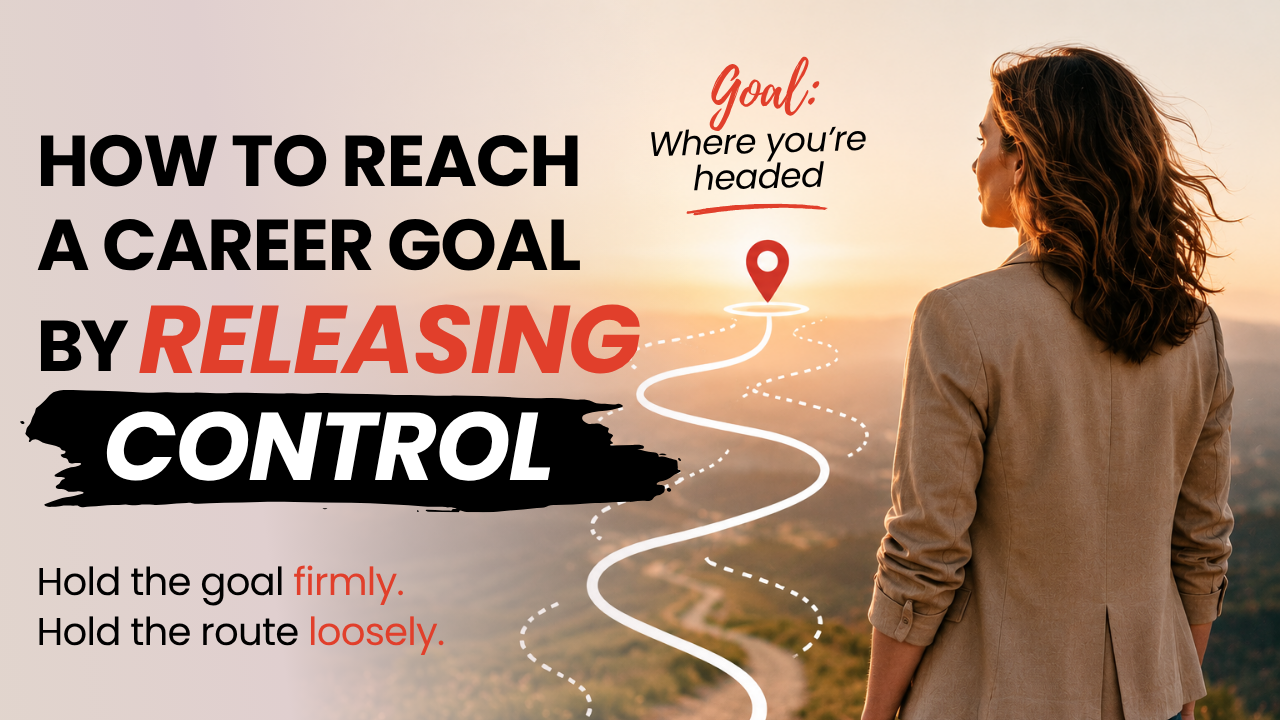
The plan I made in 2016
I want to tell you about a plan I made in 2016.
I wrote the whole thing out. The position I wanted. The company I wanted it at. The two roles I'd have to move through to get there. The timeline — three years, maybe four if things got slow. I had it mapped out in complete detail.
And none of it happened the way I wrote it. Not the order. Not the timeline. Not the roles I thought I'd move through.
You're probably waiting for the disaster. A layoff. A huge life event. There wasn't one. Where I actually ended up was better. Better role. Better scope. Better culture. Bigger vision. I couldn't have written that version of my career down in 2016, because I didn't know it existed yet.
Here's the part I got wrong, and it's the reason for this whole episode. My goal wasn't the problem. My goal was good. What I got wrong was that I thought I also had to control how I got there and when it would happen. Trying to control the route and the timeline is what kept me from something better.
So today is about the difference between holding your goal firmly and holding the path to it loosely. You need both. Most women do the opposite of both — they're loose on the goal and they grip the path.
Hold the goal firmly and the route loosely — two different jobs
I want to separate two things that you have been treating as one thing.
There's your goal. And there's how and when your goal happens.
Your goal, you hold firmly. I am not here to tell you to loosen up on what you want, or to soften it, or to stay flexible about the outcome. Pick the real thing. Make it specific. Make it measurable if you can. Build the strategy, name the milestones, and go execute like you mean it.
That is not the part you release.
The part you release is your grip on the route and the timeline. The exact order of the steps. The specific role you move through next. The month it's supposed to happen. The particular person who's supposed to give you your opening. The expectation that it unfolds exactly the way you planned it.
Here's what I see happen. A woman sets a goal, and then she decides there's only one acceptable way for it to come true. So now she's not just working toward the goal. She's insisting it happen a specific way, on a specific timeline. And that insistence is the problem.
You hold the goal firmly. You hold the route loosely. Those are two different jobs.
Most women do it backwards. They're vague about the goal — they'll tell you they "want something different" — and then they're rigid about how it has to look while it happens. That's the wrong way around.
The route and the timeline were never yours to control
Now let me tell you why gripping the route costs you so much. It's because the route was never actually in your control to begin with.
Think about what the timeline of a career change actually depends on. Budget cycles. A reorg you didn't see coming. Somebody retiring early. Somebody not retiring when everyone thought they would. A hiring freeze. A new leader who changes everything six weeks after you'd planned your move.
You can execute perfectly and still not hit the timeline, because you were never the only thing determining it. Most of what sets the timeline is outside your control.
So when you grip the route, you're not actually controlling anything. You're just refusing to accept that you can't. And that refusal has a cost, and the cost is real.
Watch how this runs, because it's The Model, start to finish.
The circumstance is neutral. Your career is changing, and you can't see the whole path from here. That's the fact. That's all it is.
Then comes the thought: I have to control exactly how and when this happens, or it won't happen. That thought is the problem.
Because that thought produces a feeling. Anxious. Tense. On edge about whether it's happening fast enough.
And a woman in that state acts on it. She forces steps that aren't ready. She says no to anything that isn't part of her original plan. She treats every delay as failure and every unexpected turn as a threat.
And the result is the thing she feared. She's exhausted, she's turned down opportunities that could have helped her because they weren't the ones she was expecting, and she's more convinced than ever that this is impossibly hard.
The thought created the result. It almost always does.
Stay open while you execute — better opportunities arrive off-schedule
So while you're doing the work — hitting your milestones, learning what's working and what isn't — I want you to stay open to the possibility that something better than your original plan could show up. And I don't mean that as wishful thinking. I mean it practically.
Opportunities do not arrive labeled. Nothing shows up with a note that says this is the thing. It shows up as a coffee invitation. An introduction from someone you barely know. A side project nobody's paying for. A message from a woman who heard you speak two years ago.
And when you're focused on controlling the route, you measure every one of those against your plan. Does this get me to my goal, on schedule, the way I planned it? And because you can't know that yet — you pass.
You pass on the coffee. You leave the message in your inbox for eleven days, and then it's too weird to respond. You say you're too busy for the side project. And you are. And that's true. And it's also the reason nothing new is entering your life.
Being open doesn't mean saying yes to everything. It means taking the next small step before you can see where it goes. Send the message. Take the call. Have the coffee. You're not committing to a new path. You're collecting information — and information is what you're actually short on. Not clarity. Not confidence. Information.
Almost everything I have right now that matters — this business, the biggest relationships in my career, the work I actually love — came from something I said yes to before I could see where it went. None of it arrived on my timeline, and none of it was part of my original plan. If I'd controlled the route as tightly as I wanted to, I would have said no to all of it.
I couldn't have planned any of it. I could only be available to it.
And there's a version of this that catches women who are already doing well, so I want to name it. Your situation improves, but your standards don't move with it. You get into the bigger room — better title, better table — and you keep evaluating everything with the standards you built in the smaller one. I did it myself. I got a scope I'd chased for years, and I spent the first six months doing the exact job I'd done before, just more of it. Nothing about that new role required me to stay small. I just kept operating at my old level out of habit. Staying open means noticing when your situation has grown and letting your ambition grow with it.
Releasing control is an identity shift, not a tactic
Here's why this is so hard, and why I can't just tell you to do it and have it stick.
Being able to pursue a firm goal without controlling exactly how it unfolds is not a technique. It's not a tip. It is a different kind of person than the one most high-achieving women have trained themselves to be.
Because think about how you got here. You got here by controlling things. By being the one who had the plan, who caught the problem early, who made sure nothing slipped. Control is not a character flaw for you — it's the skill that built your whole career. It's the thing you get praised for.
So when I tell you to let go of controlling the route, I'm not asking you to try a new tactic. I'm asking you to ease up on the exact behavior that got you everything you have. Of course that feels risky. Control is the thing that's always made you feel safe.
In the framework, this is Stage 4. Become the Person. It's the stage where the strategy stops being something you execute and starts being something that requires you to change. Because you can have a flawless plan and still not be the kind of person who can execute it without controlling every step. And if you can't do that yet, the plan won't save you. You'll force it off course trying to manage it.
The identity shift this episode is asking for is specific. You're becoming a woman who can be certain about what she's building and open about how it arrives. Those two things sound like opposites. They aren't. Being able to hold both at once is the skill.
When you hit the milestone, that's when you re-engineer
Now here's the part that keeps this from turning into chaos. Because someone is listening to me say "stay open, release the timeline" and hearing "change your plan whenever you feel like it." That is not what I'm saying.
You stay the course while you're in the work. You hold the goal, you hit the milestones you set, and you don't rewrite the plan every time you have a hard week or get an interesting invitation.
And then you reach a milestone — a real one, one you named in advance — and that is the moment you're allowed to re-engineer. That's when you stop, and you take everything you learned on the way to that milestone, and you look at the whole thing again.
In the framework, this is Stage 5. Recalibrate. And it's the stage almost everybody skips, because it doesn't feel like progress — it feels like admin, or like second-guessing yourself. It's neither.
At the milestone, you do three things.
You reflect. You look at what actually happened on the way here. What worked. What didn't. What you're better at now than you were. Who you know now that you didn't know then. What lit you up, and what you were relieved to hand off.
You reassess. You ask whether the goal you set still fits the woman who just hit this milestone. Because she is not the same woman who set it. She has more information, more range, and more proof of what she can do. She's allowed to want more now. She's allowed to want something different.
You reorient. And this is the part where everything is back on the table — on purpose. The next milestones. The timeline. The how. And yes, sometimes the goal itself, now that you can see further than you could when you wrote it.
That's the sequence. Hold firm while you execute. Re-engineer at the milestone. Not before.
The destination can change. But you change it because you reached a milestone and learned something real, not because the plan got hard and you wanted out.
In 2016 I couldn't yet see what was available to me
So let me answer the question I opened with. What got me somewhere better than my 2016 plan?
The goal didn't fail me. My grip did. I'd decided not just what I wanted, but exactly how and when it had to arrive. And when it didn't happen that way, on that schedule, I almost missed the better opportunity that showed up instead.
What actually got me there was holding the goal and letting go of the route. I stayed the course through the work, and when I hit the marks I'd set, I stopped and reassessed with everything I'd learned. And every time I did that, I could see further than I could before.
It isn't that my plan was wrong. It's that in 2016 I couldn't see far enough to know what was even available to me.
Neither can you. That's not a flaw. That's just what it is to be at the beginning of something.
So hold your goal with everything you've got. Loosen your grip on how and when it shows up. Stay open while you work. And when you hit the milestone, that's when you reassess and adjust the plan.
Not sure whether what you're feeling is burnout, a plateau, or something you've outgrown? Start with the diagnosis. The Career Burnout Signals Quiz takes two minutes and tells you which of the five career signals you're actually experiencing.
In the middle of a decision that's too important to make alone? That's what Red Chair Sessions is for. No Zoom. No scheduling. You send the situation, you get strategy back.
Stay bold. — Jamesyn
Stay connected with news and updates!
Join our community and get access to exclusive resources.
We hate SPAM. Don't worry, your information will not be shared.