
The Repeatable Framework Behind Every Major Career Reinvention
Jun 05, 2026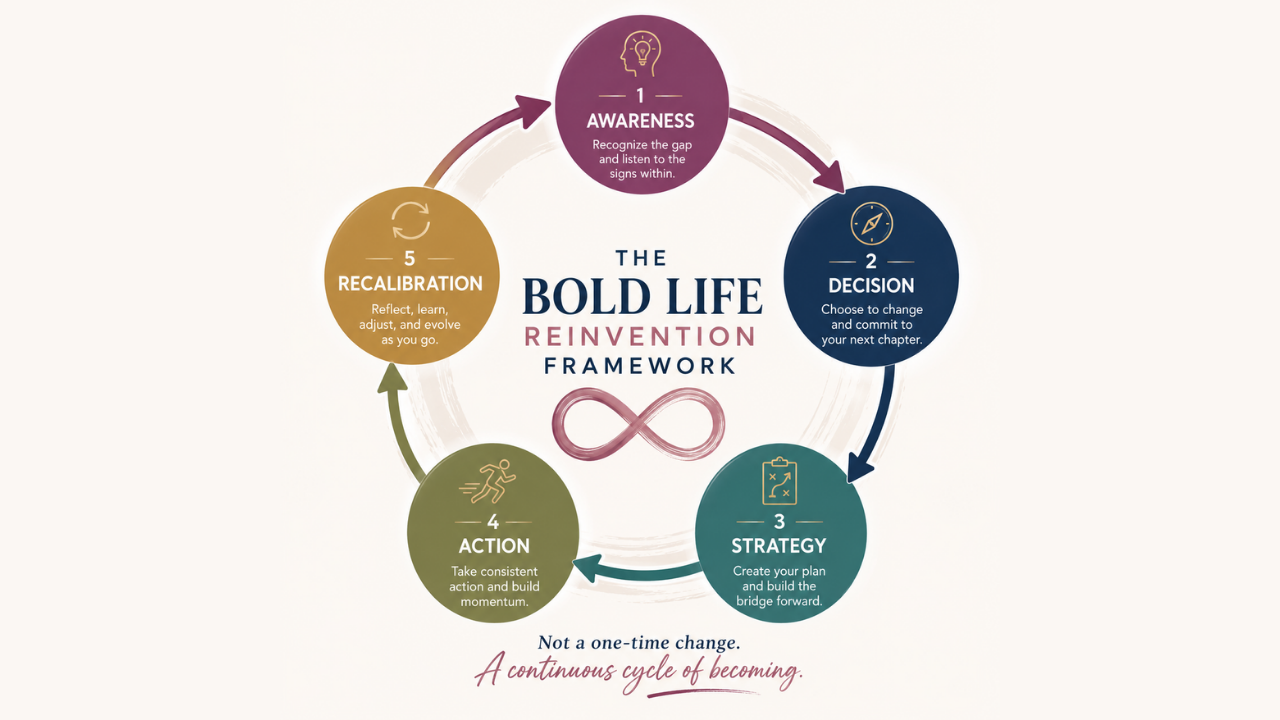
One of the biggest myths about career reinvention is that successful people somehow know exactly where they're going before they begin. That accomplishing big things requires having some magical talent the rest of us don't possess.
Well, that's not true.
Most women considering a career change aren't lacking ambition, intelligence, capability, or work ethic. They're stuck because they're trying to figure out the entire journey before taking the very first step.
Responsible women, we want the Magic 8 Ball. We want proof beforehand that success is waiting on the other side of the risk before we're willing to make a move.
And that's not reasonable.
Women know something needs to change, but they're often unsure of what comes next.
And I understand that feeling because I've lived it multiple times.
I've left one career and entered another - strategically. I've spent years figuring out where I belong. Should I stay, should I go, how far up the ladder can I be?
I've intentionally pursued leadership, and today I'm building a business.
At every stage, I've experienced the same challenge. I could see that my current path no longer fit for whatever reason, but I couldn't yet see the full path ahead.
Looking back now, I've realized that every major transformation I've made by following the same process.
The destination changed, but the framework didn't.
And that's important because career reinvention isn't about having all the answers up front.
It's about having a process for navigating uncertainty and making a plan to get started. At least today, I want to share that process with you.
Whether you're burned out, plateaued in a role, misaligned with your job or organization, outgrowing your career, pursuing leadership, or considering entrepreneurship, transformation becomes much easier when you understand the underlying framework. I call it the Bold Life Reinvention Framework.
It's no secret that this framework, like many others, has roots in coaching and instructional design models.
But over time, it became something much more personal.
It became the process I used, knowingly and unknowingly, to navigate every major reinvention in my own life.
Essentially, this is about project managing your career transformations.
And while the destinations change dramatically over the years, the framework has remained remarkably consistent.
Let me show you what that looked like in my own life, and I hope that then you will start to understand how you can apply it to your own big transformations.
Quest #1: Leaving Teaching
The first major career transformation I made in my post-college life was leaving teaching.
At the time, I didn't have a master plan.
I certainly didn't have a vision of becoming a senior manager in robotics, of all things, in medtech product education.
I wasn't dreaming about this particular type of leadership, and I definitely wasn't dreaming about entrepreneurship.
I was simply experiencing a growth sense that teaching, at least in this capacity, was no longer a fit.
Recognizing the Gap
And there was nothing objectively wrong with teaching. In fact, I loved it. Many aspects of it. I enjoyed helping people learn.
I love learning. I loved teaching, and I especially loved designing learning experiences. But over time, I began to feel restless and resentful.
I wasn't meeting my financial goals.
I didn't feel supported in many ways that I not only needed, but expected.
And with each passing year, I felt further away from the future I wanted.
What I know now is that I was experiencing both misalignment and boundary overload.
The life I was living no longer matched who I was becoming, especially when I had a baby bundle of joy coming into my life.
And many women experience this.
They assume something is wrong because they're unhappy.
But often the unhappiness isn't the problem.
It's the signal.
The signal that you've outgrown something simply, even if that something is a career that you intentionally chose, that you worked so hard for, and probably expected to stay in forever.
We feel really bound to our decisions.
This essentially is a lesson in letting go of that.
Making the Decision
I reached a point where I could no longer ignore the gap between what I was giving and getting and what I needed and where I wanted to go. I didn't know exactly what I wanted, but I knew I couldn't stay where I was.
So I had to let something that I loved go.
And that wasn't easy.
But it's an important distinction to note.
Many women believe they need complete clarity. They need to know where they're going, what they'll get there, how much they'll get paid, and whether it'll turn out right before they can move.
I didn't need that.
I simply made a decision.
I moved into something else.
Now, don't get me wrong, I'm not advocating for up and quitting your job tomorrow unless you have a substantial financial cushion. But I'm also a huge advocate for building a strategy to move.
So become a woman with a plan.
Building the Strategy
And my strategy, it wasn't to find my dream role.
This wasn't a big, hairy, audacious goal.
It was possible to be done within a year.
So my strategy was much simpler - Take what I love about the job that I have, what I'm good at, and transition with those skills into corporate.
And that was it.
Eventually, I found a perfect crossover opportunity.
It was in the summertime, and so I took the leap, not because I had certainty, but because it was going to be a bridge role.
It allowed me to gain experience in educational technology, which was where I wanted to go.
But that one opportunity became the first stepping stone into corporate learning and development.
Part of my strategy was simply getting my foot in the door.
I did the work required to make that initial transition, and then I planned to leverage the new assets I had for the next opportunity.
And I didn't stop there. I did get some education. I developed some toolsets to build my resume.
Nevertheless, I wasn't trying to solve the next ten years.
I was trying to solve for the next big step.
And that's where many people get stuck. You're creating a plan for a starting point, a draft strategy for a draft goal that is sure to change as you change.
The goal isn't to predict every twist and turn in the journey.
The goal is to build enough momentum to learn what comes next.
Because once you become this, you realize you can do that.
And once you do that, an entirely new world of possibilities opens up.
The future expands as you expand.
See?
Becoming the Person
Planning your reinvention should be concrete. And if it changes, so what?
It's supposed to change.
There's a second piece that matters just as much: the identity evolution piece.
Identity evolution influences how quickly you achieve your goal and how far beyond it you might eventually go.
If you don't do the identity work, you can move into a new chapter while still dragging your old limitations along. Your old problems. Your old personality issues.
You can change careers without changing yourself.
But that doesn't necessarily end in evolution.
Leaving teaching required more than just changing jobs.
For some time, I sat in my thoughts, How am I going to break into this industry?
It required changing how I saw myself and what I believed I was capable of first, because that was what led me to even submit a single application.
It required confidence, willingness to fail, and a willingness to make mistakes.
It was an identity change.
The career change was simply the visible outcome.
And by turning my strategy into consistent action to get to this new role, it paid off.
And that was just because I worked the plan for reinvention.
Over the next seven years, I moved through multiple roles and eventually into people leadership.
I didn't love every step along the way.
Some things we do have to work for. Sometimes you have to rebuild credibility. Sometimes you become a beginner again.
At the same time, I knew that there were benefits to going into corporate.
I said to myself that I was going to go and sit in a cubicle for five years and never complain about not having 35 kids standing there asking for me.
Another benefit was that I knew this would significantly increase my income. And that was a huge part of it at that time. I needed that.
Those are exactly the kinds of trade-offs we evaluate during the decision and strategy phase as we think about and build the plan for our next chapter.
We're asking ourselves:
What is change worth to me?
What am I willing to give up?
If you understand your key priorities today and balance them with what you're willing to build for tomorrow, you have a much better chance of making decisions that you can grow into peacefully.
Recalibrating
The hardest part of making a change is figuring out the next forever move.
But I've got news for you.
Very few moves these days are forever moves.
You're not a 1950s man working at the same company for 40 years before retiring with a pension.
The average person will change careers multiple times throughout their lifetime today.
And personally, I love that.
I feel like it reinforces the idea that we're evolving beings, that we always want to keep learning, growing, and changing our ideas about what we want.
When I left teaching, I thought I was walking away from the opportunity to retire in one of the best districts.
And at the time, that was a difficult thought to let go of.
And it was fear-based.
What if I don't find something better?
But I had to remind myself that, even though living and doing that was a nice image, I knew, internally, it wasn't the future I wanted.
I wasn't going to live in that spot for 30 or 40 years and just teach English. I am way too wild inside for that.
Anyway, I knew I wanted more.
I thought that because I'd earned a master's degree and a teaching credential, teaching was supposed to be my final destination.
But it was simply the first quest.
And for a short time, leaving teaching felt like the entire transformation.
Like, oh, I've done it.
I made the jump.
But now I can see it was simply the first application of a framework that I would use over and over again throughout my life.
That's one of the biggest lessons I want listeners to hear today.
The framework of reinvention matters way more than the specific goal.
Because once you understand how the transformation framework works, you can apply it to almost any challenge, opportunity, or reinvention you encounter throughout your career.
You simply follow the plan to get results.
Quest #2: Finding My Niche and Becoming a Leader
When I entered corporate, I thought I had solved my problem.
I had escaped the career that no longer fit, right?
Mission accomplished.
Except it wasn't.
Because very quickly, another gap and another aspiration appeared.
Recognizing the Gap
This time, the problem was that I still hadn't found my place.
I was learning, growing, and building skills. You can't just take a leap or pivot into a new career direction and expect it to happen overnight. We have to be willing and diligent about doing the work to fill the gaps that we have to get there.
But over time, I found myself increasingly drawn towards education, technology, innovation, and eventually med tech.
I wasn't following some perfectly designed master plan that said, "Yeah, I want to work in this area" at all, but I was paying attention.
I was gathering clues. I was noticing what energized me, what challenged me, and where my strengths seemed to create the most value.
And despite the fact that I never identified as a medical science person, here I was, starting to feel really competent in this industry.
And eventually, another realization surfaced.
I didn't just want to contribute. I wanted influence. I wanted leadership.
I realized it was really a desire for greater impact.
I wanted a larger voice.
I wanted greater responsibility.
I wanted the opportunity to shape outcomes rather than simply execute them under other people's direction.
Making the Decision
So again, there is a goal. You become aware of it, make a decision, then move into the action steps and identity preparation so that when you get there, you feel ready for it. Your identity has probably shifted by at least 75%, to the point where you're ready to take on the job and learn in that capacity.
Moving into leadership was one of the biggest decisions of my professional life.
It didn't just happen to me; I decided I wanted to go there.
I decided that I was willing to put in the work to grow into it.
And for all of us, it's the same. You decide you're willing to take responsibility for creating opportunities, for removing roadblocks instead of waiting for magic or for someone else to hand these opportunities to you. You intentionally upskill. You absorb every lesson, opportunity, and experience available to you.
Well, that's what happened for me.
I decided that leadership wasn't just something I admired.
It was something I wanted to achieve.
But I also knew it was someone that I wanted to become.
Building the Strategy
That journey took years, and that's exactly why I think it's important to share.
We often look at someone's title and assume, Oh, they got there quickly. There's just something better about them than me.
But what we don't see is everything that happened beneath the surface.
I made a lot of mistakes. I built credibility.
I expanded my skillset. I improved in many ways.
I'm a naturally strategic person, but there was an opportunity to learn more about the more detailed, analytical, and technical aspects.
So I had to lean into any gaps that I identified within myself, and not just to learn those things, but to learn how to demonstrate those things to leadership, to figure out how to show up so that the work I'm doing is being valued by those people in charge.
Every step revealed the next step.
Almost naturally, the strategy I followed evolved continuously as I became more reflective and began to understand myself and what would make me happy.
So I continued at every step and milestone to pivot a little in terms of my goal.
What started as a quest to leave teaching eventually became a quest to find my niche.
Then it became the quest to become a leader.
Different goals, same framework.
Becoming the Person
And this was perhaps the biggest identity shift of all.
I had to stop measuring my value solely by what I personally accomplished within an organization.
I had to stop thinking like an individual contributor and start thinking like a leader.
I had to learn how to influence, delegate, trust others, relinquish control, communicate at a higher level, make decisions amid ambiguity, and live with an uncertain future while remaining flexible.
Promotions weren't the transformation. The transformation was the person I became on the journey towards the goals I wanted to tick off the list.
It was more so the daily effort, the consistent growth, the accumulation of knowledge, skills, experience, and perspectives. Those were the real milestones in my identity growth toward leadership.
Yes, it took nearly eight years to reach the role that had eventually become my dream job.
And more than four years later, I still have aspirations for something bigger that's coming next.
I'm never going to stop.
I'm never going to be complacent.
You don't have to quit your life to start something new. You can always add to your life.
Growth doesn't stop when you arrive at your previous destination.
The goal you have today may feel like the finish line, but when you get there, you'll often discover it's simply another starting line at every stage.
Recalibrating
Just when I thought I'd arrived, another gap appeared.
Another challenge, another opportunity, another quest.
Right now, I'm on a quest to build my entrepreneurship role as I move towards retirement.
But even if I think that is the North Star for me today, I suspect my plans will continue to evolve for the rest of my life because that is who I am.
Even though I love my career right now and still feel aligned, challenged, fulfilled, and growing, another call for expansion has emerged.
Because growth in you creates new possibilities for you.
Ambitious women tend to outgrow even the things they once desperately wanted.
That's not a flaw.
That's evolution.
Eventually, I found myself asking a new question.
What would it look like to build something of my own?
What would happen if I pursued the work that was pulling at my heart to help other women work through some of their career struggles to get to a place where they can feel purposeful, they can feel meaning, fulfillment, and security?
What would my next chapter look like?
Those few questions brought me to a new awareness.
And just like before, I couldn't fully see the destination.
But I was starting to see the next step.
Quest #3: Building The Bold Life
This is the quest I'm currently living - Building The Bold Life.
Unlike the first two stories, this one doesn't have a neat ending. Yet in many ways, that's exactly what makes it exciting for me at this stage.
As a seasoned leaper of faith, I've learned that part of the adventure is embracing the unknown.
Recognizing the Gap
Even as I built a successful corporate career, another vision couldn't help itself from quietly emerging.
This desire to create.
A desire to help women navigate these same transformations that I've experienced.
A desire to build something that belonged to me.
The gap wasn't dissatisfaction with one thing.
The gap was just identifying potential in me.
Not one area of your life can fulfill everything that you need it to be, right? Sometimes we need multiple pockets to meet different needs from different areas.
And I'd finally reached a version of success that many people would consider enough.
Growing up in a small town, I largely followed the script that I'd been given.
Just get a reliable career, build a family, create stability.
End of story.
But it does bring up questions.
How many of us are stuck in career scripts that were scripted for us and that we wouldn't have chosen had we known about more possibilities and had we had more confidence in ourselves?
I realized that as I continued to grow, there were dreams I'd never fully given myself permission to explore.
It's not because they weren't possible; they just weren't visible to me.
As I grew and expanded my environment, I honored my own ambitions more and more, and I began shedding these silly expectations that no longer belonged to me.
I didn't accept the status quo anymore, and I knew there was another chapter waiting to be written.
I just needed my identity to catch up to the place where she—we—were ready to become future me.
People occasionally ask me why someone with a successful corporate career and a pathway towards executive leadership opportunities would want to invest time and energy into entrepreneurship.
The answer is pretty simple.
It's an expansion.
It's not about escaping something at this point.
It's about growing into something.
Making the Decision
I stopped treating the idea like a someday dream.
I made a decision.
I started the podcast.
I made a goal of 100 podcasts.
And guess what?
This is the result of episode 51. I am more than halfway there, and that is pretty awesome if I do say so myself.
I started coaching. I started to build infrastructure to teach all of the things that I'm good at teaching.
It was a light bulb.
And honestly, that decision changed everything.
Not because it immediately created results.
No, I'm playing the long game here.
But because it created momentum.
The same thing had happened when I left teaching.
The same thing had happened when I pursued leadership movement.
Just getting started on your plan changes everything. It kicks you into gear to keep moving towards your dreams. Not because movement guarantees success, but because movement creates that clarity and more clarity.
Building the Strategy
And all of a sudden, you've really niched down into a particular area that you want to focus on for the next and near term.
Podcasting, writing, coaching programs, offers, experiments, refinements.
Some things worked.
Some didn't.
But movement created that clarity, not the other way around.
I didn't know what would happen because this quest was never just about building a business. It was about proving to myself that I could show up authentically and allow myself to be seen.
It was about shifting that identity.
That was the challenge.
That was the why.
That was the momentum.
And just like every other reinvention, the strategy, of course, wasn't perfect because I wasn't perfect.
It was simply the bridge to the next thing.
Becoming the Person
So entrepreneurship has required another identity shift.
A big one.
Founder, creator, thought leader, business owner, marketer.
You have to pick up a lot of hats in this startup atmosphere.
Those identities don't magically appear because you launch a website, right?
You have to grow into them by continuing to show up, to do the work, to take risks, to fail, to become more visible than you want to be, and to allow yourself to be vulnerable.
Sharing ideas before they're perfect and creating before you're ready.
You create it now, and you can refine it later, but get going.
And honestly, I'm still growing into this identity, and that's going to take some time.
Just like I was still growing into leadership years after becoming a leader, just as I was still growing into corporate years after leaving teaching.
You don't become the person first and then pursue the goal.
You pursue the goal and become the person along the way.
Then you recalibrate.
You reassess.
Recalibrating
Every month brings new lessons, insights, adjustments, and opportunities.
The strategy continues to evolve because transformation's never a straight line.
It's an ongoing process of adaptation.
And maybe that's the most important lesson of all.
None of these quests were visible when I started the previous one.
I had no idea where I was going.
When I left teaching, I couldn't see leadership in corporate.
When I pursued leadership, I couldn't see entrepreneurship on the horizon.
When I started The Bold Life, I couldn't see what it might eventually become.
But it's becoming clearer to me every day.
The future revealed itself because I kept moving, not because I figured everything out in advance.
That's why I believe so strongly that career reinvention isn't about predicting the future.
It's about becoming the type of woman who can create what she sees as a possibility.
What These Three Stories Taught Me
When I look back, I see three very different reinventions: leaving teaching, finding my niche and pursuing leadership, and building a business.
Three different goals.
Multiple milestones.
Different challenges for different reasons.
But underneath each transformation was the exact same process.
The Bold Life Reinvention Framework.
First, awareness. I recognized the gap.
Then I made the decision.
Then I built the strategy.
Then I became the person.
Then I recalibrated relentlessly.
It's a giant cycle of going through the whole pattern again and again to see if you're on the right track and to reorient yourself.
That's the framework, and that's exactly the work we do at The Bold Life.
Most women don't need just information.
What they need is a process for turning that awareness into action, moving from confusion to clarity, and navigating uncertainty or mistakes without getting stuck in it and quitting.
And often they need an objective perspective to help them move through each of these phases.
Because transformation isn't easy.
It's rarely linear.
It's not a straight line from 0 to 100.
Sometimes there are bumps and curves.
There are setbacks.
Sometimes you have to reroute totally.
But those moments aren't proof that you're failing.
They're proof you're learning.
And every lesson moves you closer to becoming the woman capable of creating the next chapter.
What I've learned through every major reinvention is that transformation isn't reserved for a lucky few.
Anyone can do it.
It's not a quick path from A to Z, though, either.
And it doesn't magically appear if you keep doing the same things that you've always done.
Because the goal isn't simply changing careers.
The goal is building a career that fits the woman you are becoming.
So become a woman with a plan.
Stay connected with news and updates!
Join our community and get access to exclusive resources.
We hate SPAM. Don't worry, your information will not be shared.