
Why Corporate Culture Exhausts Ambitious Women | The Hidden Cost of Workplace Masking
May 23, 2026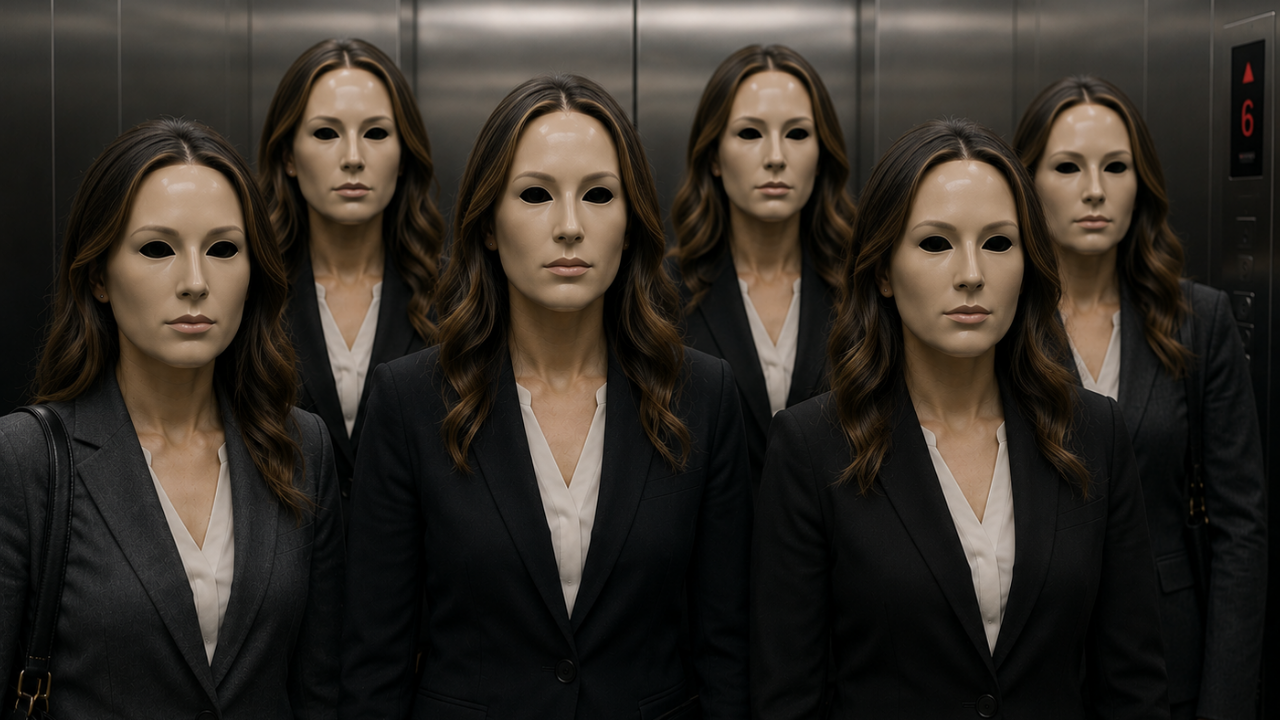
Welcome Back to The Bold Life School
In the career world, somewhere along the way, we learned that sounding polished—or generic, depending on how you look at it—matters more than sounding human.
We “leverage resources” when we mean we get humans to help us. We “navigate complex dynamics” when we truly mean that we are in a whole big mess, and we suggest that we “take it offline” when the topic is “too much” or uncomfortable in the current environment.
Why have we developed these euphemisms to replace actual thoughts and opinions? Instead of saying, “I disagree,” or “That makes no sense,” we hint at “opportunities for improvement” and straight up try to suppress unusual opinions.
It’s funny, and it’s normal. Well, we accept it anyway. But why? And what the heck?
Today, I want to talk about the masks we wear at work—the carefully managed, emotionally regulated, professionally optimized version of ourselves that knows how to say absolutely nothing in twelve well-thought-out bullet points.
The corporate mask.
And more specifically, I want to talk about:
What happens when wearing that mask becomes exhausting?
Because I’ve spent years in professional environments that are highly technical, highly strategic, highly serious. Environments where people are intelligent, capable, accomplished—and often emotionally restrained.
And if I’m being honest, there have been many moments where I’ve wondered:
Do I belong here? Am I too much for this environment?
Too passionate.
Too expressive.
Too emotionally connected.
Too intense.
Too open.
Too informal.
Too energetic.
Too human?
There are moments when I express my thoughts passionately, say how I really feel, or get emotionally honest about a situation I am dealing with, and I can almost feel myself becoming aware of myself in real time. On guard. Freezing up. Second-guessing my words. I know exactly when I’m dancing on that line of what is deemed appropriate for work and what is not.
I have thoughts like:
- “Oh. Was that too much?”
- “Should I have softened that?”
- “Should I have been more polished?”
- “Should I have held that back?”
And I know I’m not alone in this.
Because many ambitious women learn very early that professionalism often means editing yourself.
Not completely.
Just enough.
Enough to fit in.
Enough to appear composed.
Enough to be taken seriously.
Enough to avoid becoming “too emotional,” “too aggressive,” “too opinionated,” or “too difficult.”
Over time, we become incredibly skilled at performing professionalism.
But I think we need to ask a deeper question:
At what point does all of this super professionalism stop being a useful structure… and start becoming self-erasure?
That’s what this episode is about.
Not abandoning professionalism.
Not engaging in emotional chaos.
Not turning work into a therapy outlet.
It’s about questioning whether modern workplace culture has drifted too far into emotional sterilization.
And whether part of the burnout so many people feel is not just the workload itself…
…but the constant self-management and editing of the self.
Let’s dive in.
The Performance of Professionalism
One of the strangest things about modern work culture is how much performance is happening all the time.
And I don’t mean performance in terms of competence.
I mean social performance in place of authenticity.
- Tone management
- Facial expression management
- Energy management
- Emotional management
- Language management
- Personality management
You’re thinking about:
- How you sound
- How you come across
- Whether you’re too warm
- Too cold
- Too passionate
- Too quiet
- Too assertive
- Too relaxed
- Even too caring
And women especially become experts at this.
Because women are often expected to perform an extremely narrow version of acceptable leadership.
- Competent—but not intimidating
- Warm—but not emotional
- Confident—but not arrogant
- Direct—but not abrasive
- Visible—but not attention-seeking
And what’s fascinating is that many high performers become successful precisely because they learned to do this well.
They learned to:
- read rooms,
- self-monitor,
- adapt,
- manage perceptions,
- anticipate reactions.
Successful women know how to play the game.
For some people, the corporate environment is a natural expression of their personality, and I often sit in the room and wonder to myself: What are these people like in the wild?
I imagine that some people are exactly the same as their corporate selves in the wild, and if that is the case, more power to them.
But eventually, some people wake up and realize:
“I don’t even recognize myself anymore.”
That’s the danger of the corporate mask.
Not that it exists—because professionalism is necessary.
The danger is when the mask becomes so permanent that you lose access to the individual underneath it.
Why Work Starts Feeling Emotionally Draining
Masking our authentic selves over and over is one of the hidden causes of burnout that people don’t discuss enough.
Because when people think about burnout, they usually think about:
- hours,
- deadlines,
- workload,
- meetings,
- responsibility.
But there’s another layer:
Identity fatigue.
The exhaustion that comes from constantly filtering yourself. Suppressing what you really want to say and what you really think.
And I think many women know exactly what I’m talking about.
You walk into work and immediately shift modes.
Work mode requires you to leave it all behind.
You come in with a:
- different voice,
- different energy,
- different restraint level,
- different conversational style.
You become more polished.
More measured.
More strategic.
And sure—some of that is maturity.
Some of that is emotional intelligence.
Some of that is appropriate.
And some of it is the tax women pay for existing in a structure not created for them or by them.
But the problem is when the gap between your real self and your professional self becomes too large.
When the tax becomes too much to take.
Because eventually, that personality split creates misalignment.
And misalignment is exhausting.
Especially when you spend forty-plus hours a week in environments where you feel like only fragments of you are allowed to exist.
I think this is why so many highly capable people feel lonely at work, even when they are constantly surrounded by people. Even when they have great relationships, a great culture, and get accolades for their standout performance.
Because connection cannot fully happen where performance is constantly prioritized over humanity and authenticity.
The Lie That Professional Means Emotionless
So what? You might think. We all have to act a certain way at work so that we can get along, make things work, move the dial, and achieve results. But is the best way of working this method of conformity that we have found ourselves participating in?
Somewhere along the way, many workplaces accidentally equated professionalism with emotional restriction.
As though competence requires emotional flatness.
As though intelligence requires emotional detachment.
As though seriousness requires becoming robotic.
I reject that notion.
I don’t think passion makes people less professional.
I don’t think warmth makes people less credible.
I don’t think humor makes people less intelligent.
I don’t think emotional honesty makes people weak.
I would love to come here and say that the best leaders I’ve seen have been authentic, vulnerable, and human. But the reality is that I have not seen the human side of many leaders—the vulnerable side, at least.
But I would like to see more of it.
Why?
Because I believe it would allow for more connection to them and with them.
And I wonder if others might just feel the same.
As a leader, it’s important to be emotionally regulated—absolutely. But is it necessary to be emotionally absent?
Emotional regulation means that you can manage yourself responsibly.
Emotional suppression means that you disconnect from yourself in order to remain acceptable.
Those are not the same thing.
And modern workplaces often reward suppression while calling it professionalism.
Emotional Intelligence Is Not Emotional Suppression
Emotional intelligence is the ability to accurately recognize, understand, regulate, and respond to emotions—both your own and other people’s—in ways that improve judgment, relationships, communication, and decision-making.
But I think emotional intelligence is often misunderstood.
Many people confuse emotional intelligence with:
- being agreeable,
- being endlessly accommodating,
- avoiding conflict,
- suppressing emotion,
- sounding calm at all times,
- making everyone comfortable.
That is not emotional intelligence.
In many professional environments, women are especially rewarded for emotional management rather than emotional intelligence.
Those are different things.
Real emotional intelligence includes:
- Self-awareness — Knowing what you’re feeling and why
- Emotional regulation — Being able to manage your emotions responsibly instead of impulsively reacting
- Social awareness — Understanding the emotional dynamics, motivations, and perspectives of others
- Discernment — Knowing when to speak, when to challenge, when to soften, and when to hold boundaries
- Communication skill — Expressing difficult truths clearly without unnecessary destruction
- Emotional resilience — Remaining grounded under pressure instead of collapsing, exploding, or becoming emotionally avoidant
- Authenticity with regulation — Being real without emotionally dumping onto others
That last point matters.
Emotionally intelligent people are not emotionless. They aren’t pretending or suppressing, either.
They are emotionally integrated.
They are still real. They are themselves, at least in some capacity.
They don’t suppress emotions entirely, nor do they let emotions completely control them.
They can:
- feel frustration without becoming reckless,
- express disagreement without becoming cruel,
- maintain humanity without losing professionalism,
- navigate tension without pretending tension doesn’t exist.
And honestly, some workplaces confuse emotional suppression with emotional intelligence.
Someone who never challenges anything, never expresses emotion, never disrupts harmony, and always appears polished may not actually be emotionally intelligent.
They may simply be highly conditioned.
They may be deeply unhappy, lost, or insecure under the mask.
Meanwhile, someone who asks hard questions, expresses passion, notices emotional undercurrents, or challenges dysfunctional dynamics may actually possess more emotional intelligence—especially if they do it responsibly.
That distinction is incredibly important.
One is authenticity, and the other is simply lying to oneself and others to fit in.
As women at work, an important question we can ask ourselves is:
“Am I being true to myself, or am I suppressing myself to fit into this environment?”
If the answer is that you feel like you constantly have to suppress yourself, hold back, or perform in order to fit in, that may be the signal that wearing this particular mask is harming you and your personal and professional growth.
Because constant suppression of your authentic self means that you are holding back your true potential.
The Corporate Mask Doesn’t Just Exhaust People — It Suppresses Innovation
Wearing the corporate mask isn’t just about being truer to oneself and having a good time in the workplace.
There’s another cost to all of this that organizations rarely talk about.
Suppressing the self at work also suppresses innovation.
Because when people become overly focused on professionalism, hierarchy, agreeableness, and perception management, they stop saying what they actually think.
They:
- hold back ideas,
- soften critiques,
- settle for less than quality results,
- avoid challenging leadership,
- defer to chain of command,
- protect political safety instead of intellectual honesty,
- put up with more than what is reasonable.
And eventually, organizations begin confusing this type of compliance or avoidance with alignment.
And that hurts everybody.
When Smart People Learn to Stay Quiet
One of the things that frustrates me most in corporate environments is how often genuinely intelligent people stay silent because they’ve learned that challenging the status quo carries social risk.
Not necessarily career-ending risk.
Sometimes it’s subtler than that.
You risk being labeled as:
- difficult,
- intense,
- too opinionated,
- not collaborative,
- not executive enough,
- not a team player.
So people start editing themselves.
And when enough people do that simultaneously, organizations become intellectually flat.
Everyone is smiling.
Everyone is polished.
Everyone is “aligned.”
But underneath the surface, people may privately disagree with decisions, see flaws in strategy, or recognize opportunities that never get explored because the culture subtly rewards agreeableness over honest challenge.
And that is incredibly dangerous in environments that depend on innovation.
Especially in technical, creative, medical, and many other environments.
Innovation Requires Intelligent Friction
Innovation requires tension.
In fact, innovation relies on bold ideas, dissent, and wild ideas.
Not emotional chaos.
Not disrespect.
Not ego battles.
But intelligent friction.
Questioning assumptions.
Testing ideas.
Pushing against stale thinking.
Being willing to say:
- “I actually don’t think this is the best direction.”
- “I think we’re missing something.”
- “I disagree.”
- “There may be a better way.”
Real innovation requires enough psychological safety for people to stop performing agreement all the time.
The Problem With Overly Rigid Hierarchy
The nature of enterprise environments, with overly rigid corporate hierarchies, can be patronizing if they follow the false logic that high status equals better ideas, more expertise, stronger intellect, and better judgment.
Expertise and insight do not distribute themselves perfectly according to org charts.
Good ideas do not only come from the highest-ranking person in the room.
When organizations become too obsessed with hierarchy, politics, and polished professionalism, they unintentionally create cultures where people learn:
- Don’t disrupt.
- Keep your wild ideas to yourself.
- Don’t challenge the status quo.
- Don’t say too much.
- Don’t object.
- Don’t make others uncomfortable.
But discomfort is often where breakthrough thinking begins.
The Impossible Contradiction for Ambitious Women
Many ambitious women feel this tension deeply because we are frequently socialized toward agreeableness while simultaneously being expected to lead, innovate, and think strategically.
Which creates an impossible contradiction:
- “Be visionary… but not disruptive.”
- “Be confident… but not too direct.”
- “Challenge the system… but gently.”
- “Lead boldly… but make sure everyone stays comfortable.”
That balancing act can be exhausting.
And over time, many women begin self-censoring—not because they lack intelligence or insight—but because they become highly skilled at predicting the social consequences of honesty.
This is where misalignment, frustration, and feelings of defeat occur.
This workplace reality is not just emotionally expensive—it is organizationally expensive too.
Because some of the best ideas never get spoken aloud in cultures where people feel safer performing professionalism than expressing uncomfortable truths.
What Happens to Women
Now layer gender expectations on top of this.
Women already receive stronger social messaging around likability, emotional presentation, and relational behavior.
So many ambitious women are managing not only performance expectations…
…but emotional expectations.
You are expected to:
- maintain harmony,
- be approachable,
- be collaborative,
- be polished,
- be emotionally aware,
- be composed.
At all times.
And many women begin shrinking themselves professionally without even realizing it.
- Softening ideas
- Holding back opinions
- Reducing visibility
- Editing language
- Containing enthusiasm
- Suppressing anger
- Minimizing ambition
Because they learn that too much personality can become professionally risky.
But on the other hand, not being seen or heard can also mean invisibility.
Over time, many women become incredibly disconnected from their natural communication style.
Not because they’re fake.
Because adaptation helped them survive professionally.
But survival and alignment are not always the same thing.
And If This Is Hard for Me…
This is also where I want to say something important.
As a white cisgender woman, if I sometimes feel exhausted by the pressure to self-edit professionally…
…I can only imagine the additional weight carried by people who are also navigating racial, cultural, gender, sexual identity, socioeconomic, or language expectations inside corporate environments.
Because professionalism standards are not culturally neutral.
They are often built around society’s dominant norms:
- communication norms,
- appearance norms,
- emotional norms,
- speech norms,
- behavioral norms.
And many minorities carry an additional burden of code-switching.
Not just managing performance—
…but managing cultural acceptability.
Managing how safe it feels to be fully themselves.
Managing whether parts of their identity will be judged as “unprofessional.”
That is an enormous emotional and cognitive load—being in an environment where there is no psychological safety.
And I think workplaces dramatically underestimate how exhausting constant assimilation can become over years and decades.
Especially when organizations claim to value authenticity while quietly rewarding conformity.
When diversity, equity, and inclusion initiatives—meant to expand the perspectives in the room—have been politically weaponized in ways that reduce awareness and complex conversations about representation, bias, access, and inclusion into simplistic attacks that often delegitimize minorities’ belongingness in one fell swoop.
And if we’re not careful, canceling Diversity, Equity, and Inclusion conversations in favor of “merit” can quietly result in workplace environments rooted in bias, stereotype, resentment, and exclusion.
Plain and simple—when people are not bringing their best selves and their best ideas to the office, everyone suffers.
It matters—for all of us and for organizations.
Because many workplaces say:
“Bring your authentic self to work.”
But what they often mean is:
“Bring a carefully moderated version of yourself that remains comfortable for everyone else.”
That’s different.
Now Let Me Be Clear
I am not arguing that workplaces should become emotionally chaotic.
I am not advocating for impulsiveness, emotional dumping, lack of boundaries, or lack of professionalism.
There is tremendous value in discipline.
There is value in restraint.
In emotional regulation.
In focusing on the work.
In respecting professional environments.
In understanding context.
And frankly, not every emotion belongs everywhere.
Part of maturity is discernment.
But have we swung too far toward emotional sterilization?
Too far toward corporate performance.
Too far toward over-managed personalities.
Too far toward treating humanity itself like a professional liability.
And too far away from being ourselves?
And I think many people are starving for more realness.
Not instability.
- Warmth
- Humor
- Personality
- Honesty
- Appropriate vulnerability
- Actual connection
- Humanity
- Care about whether our colleagues are okay in the current political environment
Because we are spending enormous portions of our lives inside these workplaces.
And I don’t think the answer to high performance is becoming less human.
The Real Question
I think the real question this episode asks is:
How much of yourself should you have to amputate in order to succeed professionally?
Because adaptation is normal.
But self-erasure is costly.
And maybe part of the future of leadership is not becoming colder, flatter, and more emotionally neutral.
Maybe it’s becoming more grounded.
More self-aware.
More emotionally intelligent.
More humane.
Maybe professionalism should mean:
- integrity,
- competence,
- accountability,
- clarity,
- respect,
- emotional regulation—
—not emotional suppression.
And maybe the people who change workplace culture are the people willing to let the mask loosen just enough for others to breathe too.
And if this topic resonated with you—if you’ve been questioning whether your exhaustion is only about workload, or whether part of it is the pressure to constantly perform a version of yourself that no longer fits—I want you to take my 2-minute Career Burnout Signals Quiz.
Because burnout is not always exhaustion.
Sometimes it’s misalignment.
Sometimes it’s identity suppression.
Sometimes it’s the emotional fatigue of living too far away from yourself for too long.
You can find that at The Bold Life.
And if this episode spoke to you, share it with another ambitious woman who may be quietly wondering whether she’s “too much” for the room she’s in.
Stay connected with news and updates!
Join our community and get access to exclusive resources.
We hate SPAM. Don't worry, your information will not be shared.