
Why Less-Qualified People Keep Winning (and Why Confidence Often Beats Competence in Modern Careers)
May 16, 2026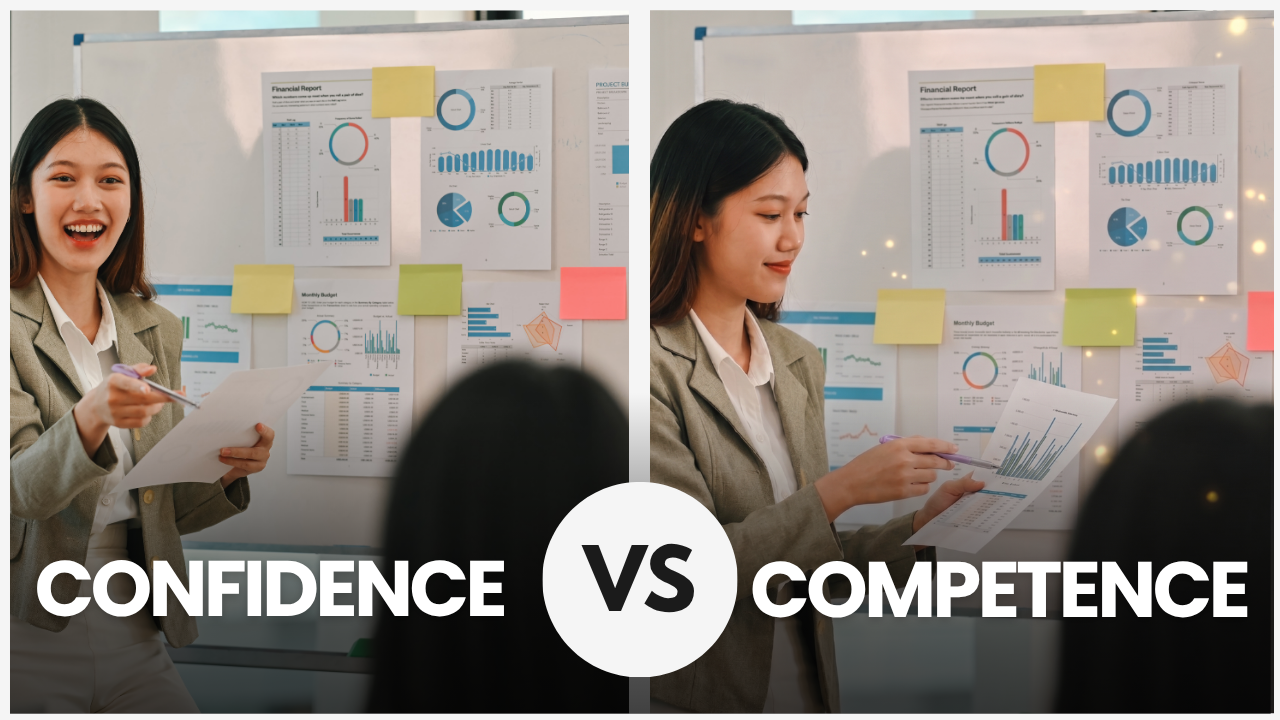
Welcome to The Bold Life School, the show that empowers you to elevate your life and step into your full potential. I’m your host, Jameson, and this is where ambition meets authenticity—where you’ll find the tools and inspiration to grow, evolve, and thrive.
Each week, we dive into powerful topics that challenge the status quo, whether it’s breaking through limiting beliefs, navigating life’s transitions, or embracing the bold moves that push you beyond your comfort zone.
Now, let’s get into today’s episode.
Confidence Is Everywhere Right Now
We are living through a very strange moment where confidence is everywhere, but confidence is being mistaken for expertise on a massive scale.
Just look at the current government administration, for example.
And I think it’s having a psychological effect on a lot of women—especially highly capable women.
Because while the loudest people with the richest friends or the most online clout are rapidly branding themselves as experts in public, many genuinely intelligent, adaptable, experienced women are sitting there privately questioning whether they know enough to even participate in the discussion.
And I need us to talk about it.
Because I had an experience this week that made me realize something uncomfortable:
I may be far more capable than I give myself credit for.
And I think many of you are too.
The Assignment That Sent Me Spiraling
A few days ago, I was overwhelmed with work.
I felt maxed out. My task list was ridiculous. And on top of everything else, I was suddenly asked to create an education webpage for robotic surgery.
Not eventually.
Not next month.
In basically two days.
Copy, design direction, visual assets, structure, marketing message, educational framing—the whole thing.
And my immediate internal reaction was:
“No. Absolutely not.”
Because when you’re already cognitively overloaded, even simple tasks can feel impossible.
And this wasn’t a simple task. This was a high-visibility deliverable inside an extremely technical field.
And what’s interesting is that I still have moments—even after over a decade in robotic surgery and med tech—where part of my brain goes:
“You’re not technical enough for this.”
“You don’t know what you’re doing.”
“How did you even get this job?”
Which is honestly wild when I say it out loud because, objectively, I know a lot.
I’ve been in education—teaching, training, designing learning strategy, instructional solutions, and high-tech products—for over 20 years.
But I think this happens to many women, especially women who adapt gradually over years.
Your capability compounds so slowly and quietly that your identity never fully catches up to your actual skill level.
The AI Gold Rush and Performative Expertise
So there I was: stressed, resistant, irritated.
And then I decided to use our company’s internal AI tools strategically.
Not recklessly. Not blindly. Not by dropping confidential information into random public systems because some influencer online said AI is magic now.
Which, by the way, has been fascinating to watch.
Suddenly, every person with a LinkedIn account is an AI futurist.
Every coach is an AI strategist.
Every consultant is an AI thought leader.
Even celebrities are getting in on it.
And some of the advice being thrown around publicly is honestly concerning—casually recommending that others upload deeply personal information, financial documents, and sensitive business data without fully understanding the privacy implications, security infrastructure, or governance models.
And I think this is exposing something really important about human behavior:
The people speaking most confidently are not always the people with the deepest understanding.
The loudest voice in the room isn’t necessarily the smartest.
The most educated—or even the most likable—person in the room doesn’t always translate to them having more to offer than you do.
Now, this doesn’t mean those people are malicious.
Some are genuinely excited.
Some are early adopters.
Some are extremely knowledgeable.
But visibility creates perceived authority.
Confidence creates perceived expertise.
It is perception.
And we are living in a culture that rewards big mouths and bold certainty—especially online.
What AI Actually Revealed to Me
So back to my situation.
I started using AI strategically to accelerate the work—not to replace my thinking, but to support it as a tool.
I used it to organize ideas, generate frameworks, pull references, accelerate copy direction, explore visual concepts, and reduce friction.
And within a short amount of time, I had built something I was genuinely proud of.
Not mediocre.
Not “good enough.”
Actually strong.
And afterward, I sat there thinking:
Why was I so convinced I couldn’t handle this?
Why was I so stressed out about this task?
Why did my brain immediately assume that I was behind somehow?
Why did I instinctively question myself while watching far less experienced people publicly position themselves as authorities every single day?
Well, this episode is not really about AI.
It’s about the confidence gap.
What Confidence Actually Is
Because I think a lot of women misunderstand what confidence actually is.
Confidence isn’t loudness.
It’s not pretending to know everything.
Confidence isn’t being perfectly ready.
Confidence is not branding yourself as an expert after watching a few videos online.
Confidence is self-trust.
It’s giving yourself credit where credit is due.
Sometimes confidence means getting visible to yourself—and that’s it.
It’s the willingness to engage with complexity before you feel perfectly ready.
And I think women, especially high-performing women, are often trained to require certainty of themselves before participation.
And that’s a very different thing than lacking intelligence.
The Way Women Minimize Their Expertise
We normalize or downplay our own expertise constantly.
We adapt so well that we stop seeing adaptation as a skill.
We survive difficult environments for years and then casually dismiss the capability it took to do that.
We want to be fair, humble, and frankly, we’re used to having to prove ourselves everywhere—especially in male-dominated industries.
We become highly competent and then say things like:
“Well… anyone could do it.”
No.
They couldn’t. And that’s the point.
You’ve just been living inside your own capability for so long that it became invisible to you.
How Competence Quietly Compounds
I think about this all the time in robotics.
I entered a highly technical field without being naturally technical.
I was not the engineering girl.
I was not the science lover.
I wasn’t the person walking around as a child dismantling computers for fun. No way.
What I was deeply interested in was learning, teaching, communication systems, psychology, growth, and education.
Those were my passions and skill sets.
And there was a place for me.
And over 12 years, I immersed myself in an incredibly complex environment.
Not because it was easy.
Not because every task was enjoyable.
Honestly, there are still parts of this job—and every job—that I don’t enjoy.
That’s why we call it work.
There are moments I get pulled into cloud systems, software development conversations, and backend architecture discussions, and I think:
“Dear God. Thankfully, we work in teams and bring all different skill sets.”
But there’s another part of me that genuinely enjoys stretching myself into these complexities.
I like learning things I once found intimidating.
I like becoming capable in a niche environment with people so different than me.
I like the challenge.
I like realizing I can survive and thrive in rooms that once would have felt totally foreign to me.
But capability didn’t arrive all at once.
It compounded quietly through repetition, exposure, problem-solving, making mistakes, listening, studying, and translating complexity over and over again in slightly different situations.
And most importantly:
Through staying.
The simple act of staying around long enough to learn the industry, trudge through the day-to-day, and climb up the ladder—that’s what led me to gain access to more exciting projects, which built confidence and gave me momentum to continue expanding in that space.
And happiness can be found because of those efforts, not necessarily in spite of the hard parts.
Take Inventory of What You’ve Already Built
So stop every once in a while and take inventory of all you’ve endured, the obstacles you’ve overcome, and the accomplishments that you’ve created for yourself in the meantime.
Many women are far further along than they realize—taking care of business at home and work, doing very hard things.
But many women are so busy performing expertise and acting as though it’s just everyday necessity that they aren’t out there publicly sharing or boasting about their successes.
And because confidence is often performed publicly while competence develops privately, women frequently underestimate themselves.
We focus on the hard parts rather than what we’ve overcome.
We think about what we don’t know rather than what skill set we do bring to the table.
We believe that if the job description asks for 100 requirements, we need to have 99 of them to go for it.
Why Less-Qualified People Keep Winning
Meanwhile, way less-qualified people move aggressively.
They apply before they’re ready, speak before they’re experts, and build before they’re certain.
And I’m not even saying that critically.
In some ways, they understand something important:
Participation itself accelerates growth and confidence.
Everyone begins as a beginner sometime.
And it’s by beginning, making mistakes, and getting messy that we build both confidence and expertise.
Meanwhile, many brilliant women are over in the corner trying to earn one more credential, one more year of expertise, one more course, one more proof point—one more signal that they’re finally allowed to trust themselves.
Low Confidence Changes Behavior
And I really want you to understand this:
Low confidence changes behavior—and not in a good way.
It changes participation.
You speak less.
Experiment less.
Build less.
Try less.
Apply less.
Negotiate less.
Create less.
You become less visible.
And not because you lack capability, but because you underestimate your own adaptability.
And adaptability is becoming one of the most important skills of the modern era—especially now.
Technology is changing rapidly.
Industries are changing rapidly.
Careers are changing rapidly.
There’s opportunity everywhere.
The people who will thrive are not necessarily the people who knew it all already.
They’re the people willing to engage with change before feeling totally comfortable.
That’s true in AI.
It’s true in leadership.
It’s true in entrepreneurship.
It’s true in career pivots.
The future will belong to adaptable people who decide and execute—not people who waited until they felt perfectly ready.
Because perfectly ready is never coming.
Humility and Inadequacy Are Not the Same Thing
And I think many women are waiting unnecessarily.
Not because they’re incapable, but because they’ve confused humility with inadequacy.
Those are not the same thing.
You can be humble and highly capable.
You can be thoughtful and highly intelligent.
You can be good and very successful.
You can be cautious and still belong in the room.
And honestly, some of the most capable women I’ve ever met are the least convinced of their own brilliance.
That should concern us.
Because the world does not only reward talent.
It rewards visible participation.
And if you spend your entire life waiting to feel fully qualified before you participate, you may spend years hiding capabilities that were already more than enough to begin.
Confidence is not pretending you know everything.
It’s trusting that you can figure it out.
And that’s the difference.
Final Thoughts
I think that’s the real growth edge for many ambitious women right now.
Not becoming someone entirely different.
Not magically transforming overnight.
But finally recognizing the evidence of who you already are and what you already know.
Because I suspect many of you are walking around with accumulated experience, expertise, resilience, adaptability, and intelligence that you’ve completely normalized.
And maybe it’s time to stop minimizing that.
Explore Red Chair Sessions
If this episode resonated with you, I’d encourage you to explore my Red Chair Sessions.
It is a private, call-free coaching and strategic advisement space for ambitious women navigating topics just like today’s:
- Reinvention
- Burnout
- Leadership pressure
- Career pivots
- High-stakes decisions
- Confidence and visibility
Because sometimes the next level of your life isn’t about becoming more capable.
It’s about finally seeing the capability that you already have.
Stay connected with news and updates!
Join our community and get access to exclusive resources.
We hate SPAM. Don't worry, your information will not be shared.